Linguistics Guest Lecture

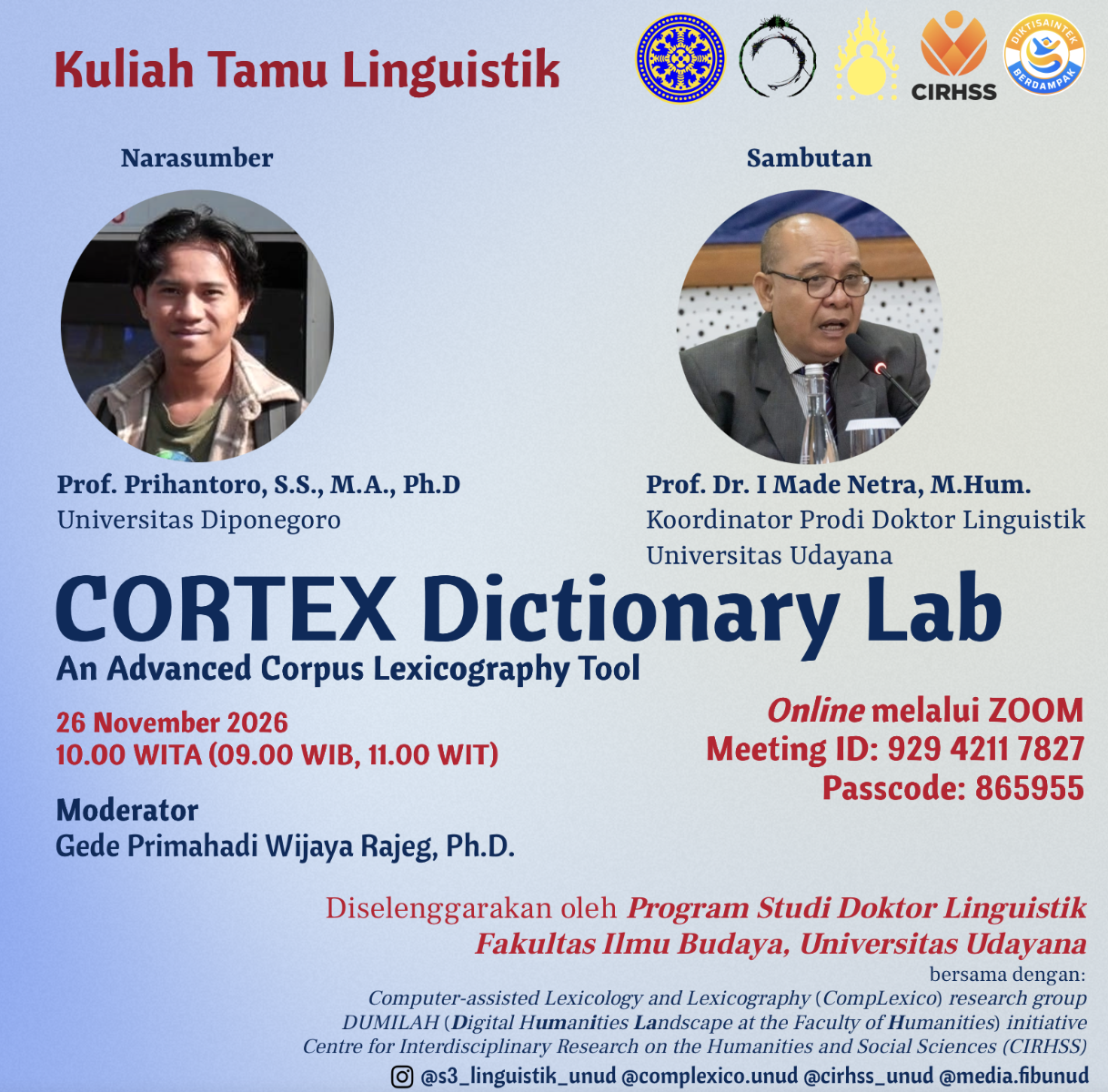
Doctoral Program of Linguistics (Faculty of Humanities, Udayana University) organises a guest lecture on corpus lexicography, featuring Prof. Prihantoro, Ph.D. (Universitas Diponegoro) as the speaker with the title: CORTEX Dictionary Lab – An advanced corpus lexicography tool. The meeting details are as follows (interactive flyer at the bottom):

  • Date: Thursday, 26 November 2026 (10 am Indonesia Central Time)
  • Meeting ID: 929 4211 7827
  • Passcode: 865955
  • Zoom Meeting Link: https://bit.ly/zoom-cortex-lab

This event is co-organised with CIRHSS and its relevant research group and focus on Digital Humanities and Linguistics, namely Computer-assisted Lexicology and Lexicography (CompLexico) research group and DUMILAH (Digital Humanities Landscape at the Faculty of Humanities) initiative (see the initiation activities with CIRHSS here).
FReTalk from Dr Mae Carroll (Univ. of Melbourne)

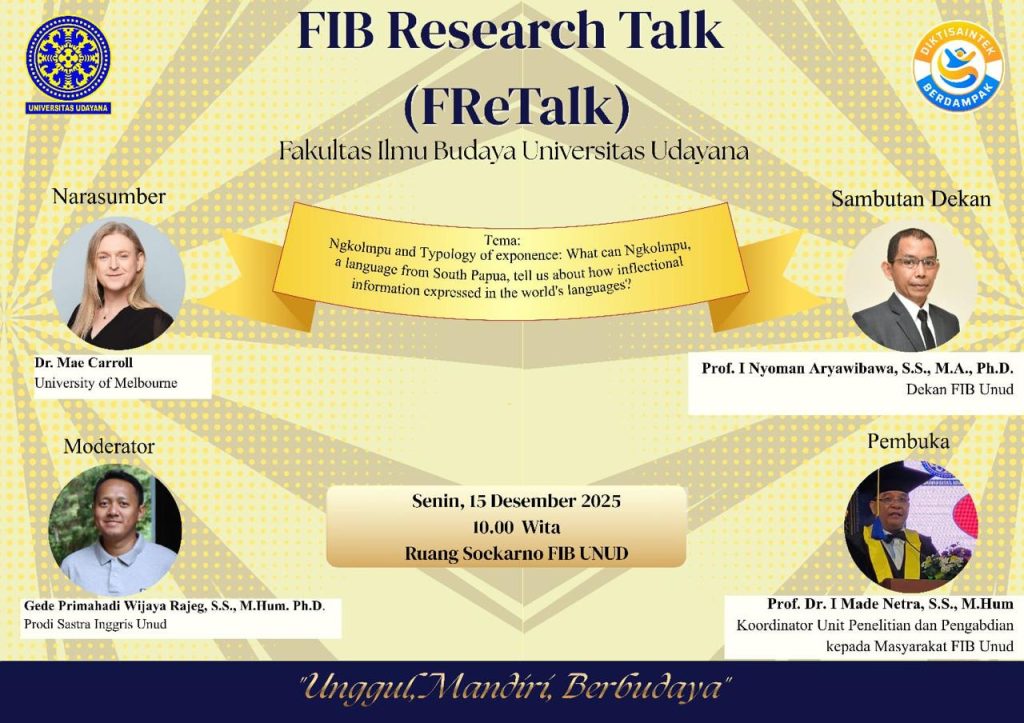
Dr Mae Carroll from the University of Melbourne as well as CIRHSS research affiliate will be giving a talk (Monday 15 December 2025 10:00 AM) at the Fakultas Ilmu Budaya Research Talk (FReTalk) series organised by the Faculty of Humanities, Udayana University. Abstract, the title, and the flyer for the talk are provided below.

Ngkolmpu and Typology of exponence: What can Ngkolmpu, a language from South Papua, tell us about how inflectional information expressed in the world’s languages?

Abstract

Arguably no part of language displays more salient cross-linguistic variation than that of inflectional morphology, i.e. the marking of categories such as number or plural within the structure of words. On one end, we have languages like Standard Indonesian which, despite rich derivational morphology, displays no inflectional morphology. At the other end the extreme, we have Ngkolmpu, a Yam language spoken by around 200 solely in the village of Yanggandur in the Merauke region of South Papua Province, Indonesia, in which a single transitive verb arguably inflects for over 3000 combinations of inflectional features. However, the true complexity of Ngkolmpu lies not in the size of the system but how it organised with each category being simultaneously marked by multiple bits of morphological material simultaneously. In this talk, I will lay out the various ways in which inflectional information may be encoded in language and exemplify these with examples from Ngkolmpu and then compare these to a cross-linguistic sample of languages from around the world to place Ngkolmpu within this space.

Flyer for the FReTalk by Dr Mae Carroll