FReTalk from Dr Mae Carroll (Univ. of Melbourne)

Dr Mae Carroll from the University of Melbourne as well as CIRHSS research affiliate will be giving a talk (Monday 15 December 2025 10:00 AM) at the Fakultas Ilmu Budaya Research Talk (FReTalk) series organised by the Faculty of Humanities, Udayana University. Abstract, the title, and the flyer for the talk are provided below.

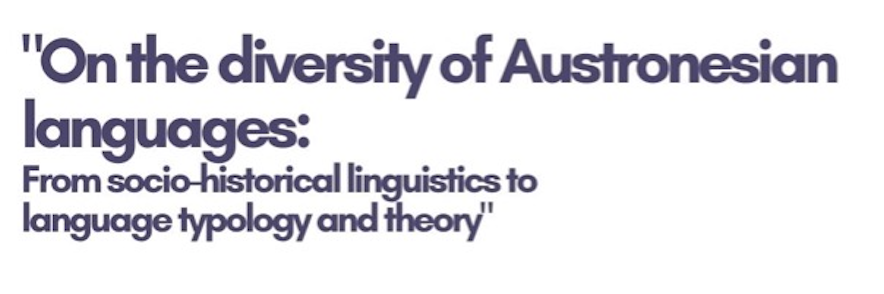
Ngkolmpu and Typology of exponence: What can Ngkolmpu, a language from South Papua, tell us about how inflectional information expressed in the world’s languages?

Abstract

Arguably no part of language displays more salient cross-linguistic variation than that of inflectional morphology, i.e. the marking of categories such as number or plural within the structure of words. On one end, we have languages like Standard Indonesian which, despite rich derivational morphology, displays no inflectional morphology. At the other end the extreme, we have Ngkolmpu, a Yam language spoken by around 200 solely in the village of Yanggandur in the Merauke region of South Papua Province, Indonesia, in which a single transitive verb arguably inflects for over 3000 combinations of inflectional features. However, the true complexity of Ngkolmpu lies not in the size of the system but how it organised with each category being simultaneously marked by multiple bits of morphological material simultaneously. In this talk, I will lay out the various ways in which inflectional information may be encoded in language and exemplify these with examples from Ngkolmpu and then compare these to a cross-linguistic sample of languages from around the world to place Ngkolmpu within this space.
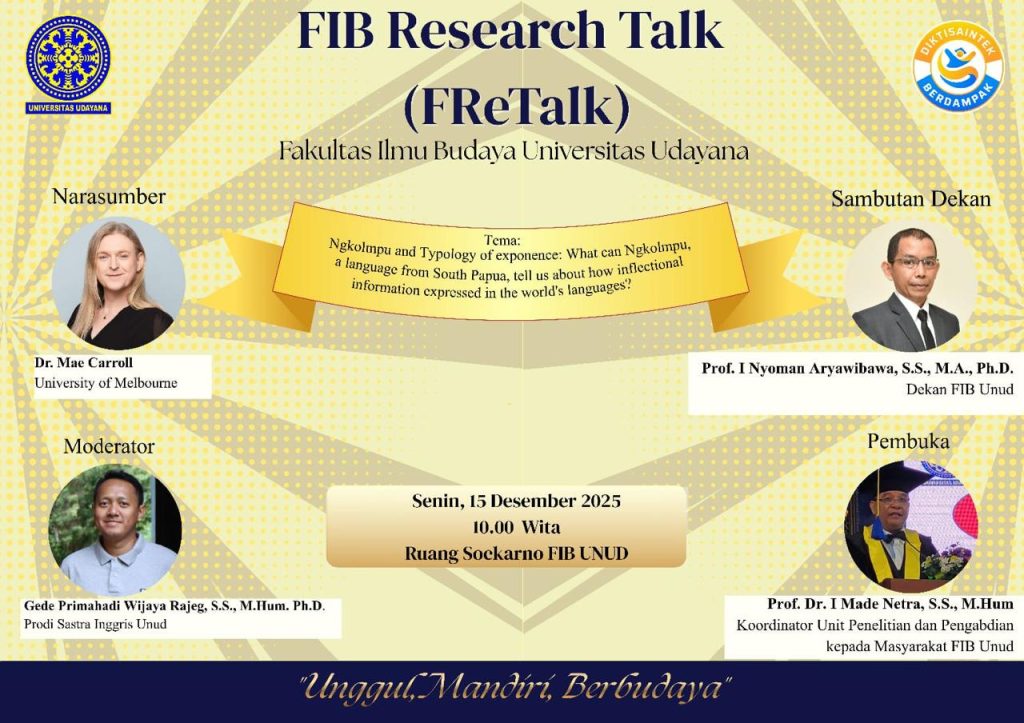
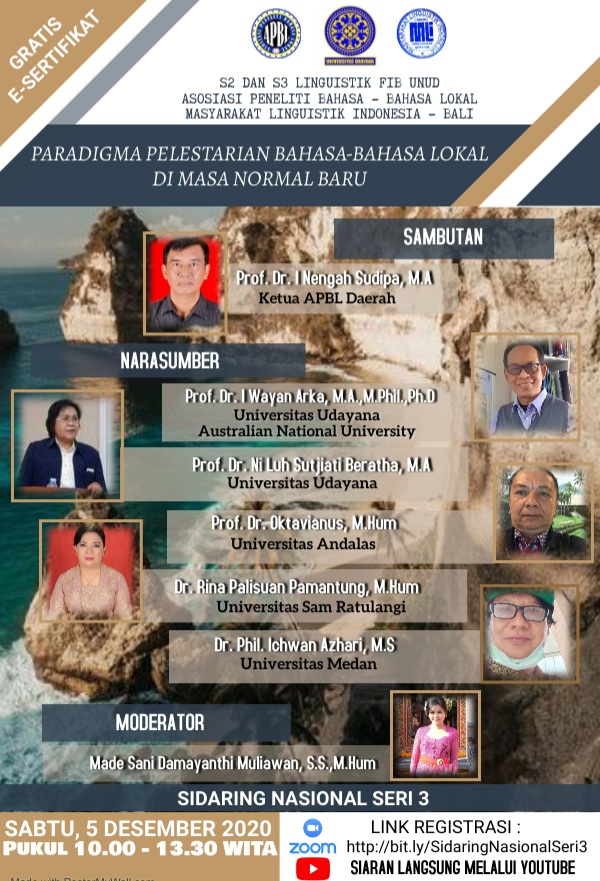
Flyer for the FReTalk by Dr Mae Carroll

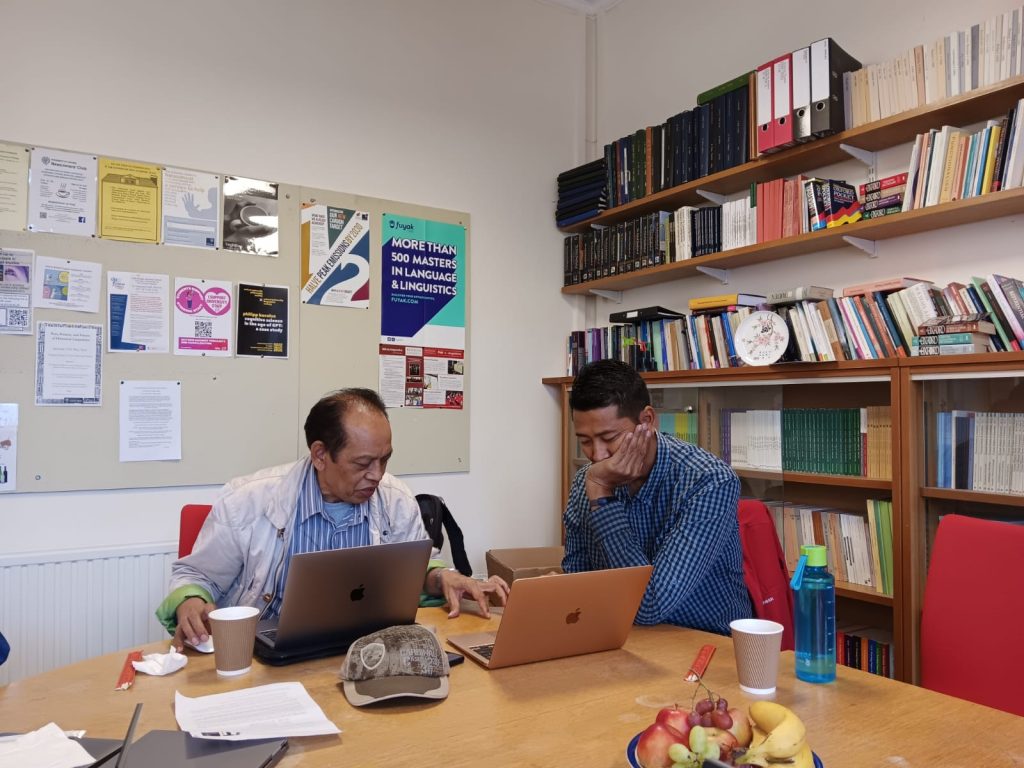
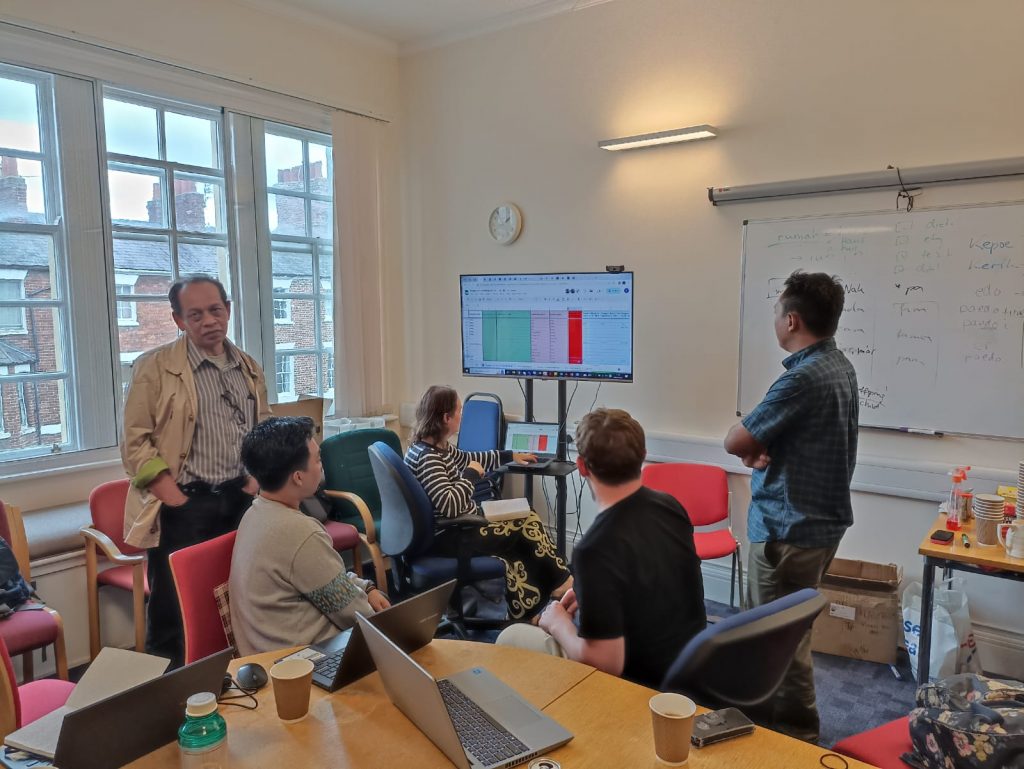
Preserving Enggano Language and Culture: A Journey of Collaboration and Research

Enggano, with about 1500 speakers, is spoken on Enggano Island, off the southern coast of Sumatra, Indonesia, with a population of about 4000. Enggano is classified as “threatened”: only the elder generation are fully competent and fluent speakers. Many children speak Indonesian and little to no Enggano. Intensified contact with non-Enggano speakers is likely to continue and spread throughout the island, to the detriment of Enggano.

Our work on the Enggano language began with a pilot visit in February 2018, where we met with elders of the five Enggano clans, recorded some traditional stories, and worked with some younger speakers to record some verbal paradigms. We also visited an elementary school and the high school, discussed our project with the headmasters and some of the teachers, and gave presentations about our project to the students.

In 2018-2019 we received funding to continue the project from the Endangered Language Fund (2018-19) and Oxford’s John Fell fund (2018-19). In 2019 we were awarded a grant by the Arts & Humanities Research Council, UK for the project Enggano in the Austronesian family: Historical and typological perspectives, and in 2022 we were awarded a second AHRC grant, Lexical resources for Enggano, a threatened language of Indonesia.

Source: https://enggano.ling-phil.ox.ac.uk

This research collaboration involves several distinguished scholars:

  • Prof. Mary Dalrymple, University of Oxford
  • Prof. I Wayan Arka, Australian National University/Udayana University
  • Prof. Bernd Nothofer, Goethe-Universität Frankfurt am Main
  • Prof. Ketut Artawa, Udayana University
  • Dr. Charlotte Hemmings, University of Oxford
  • Dr. Gede Primahadi Wijaya Rajeg, University of Oxford/Udayana University
  • Dr. Arono, University of Bengkulu and Australian National University
  • Mr. Dendi Wijaya SPd MHum, BRIN
  • Mr. I Komang Sumaryana Putra, Udayana University
  • Mr. Erik Zobel, independent researcher/peneliti independen
  • Dr. Daniel Krauße, CNRS-Lattice, ENS – Université Sorbonne nouvelle
  • Dr. Sarah Ogilvie, University of Oxford
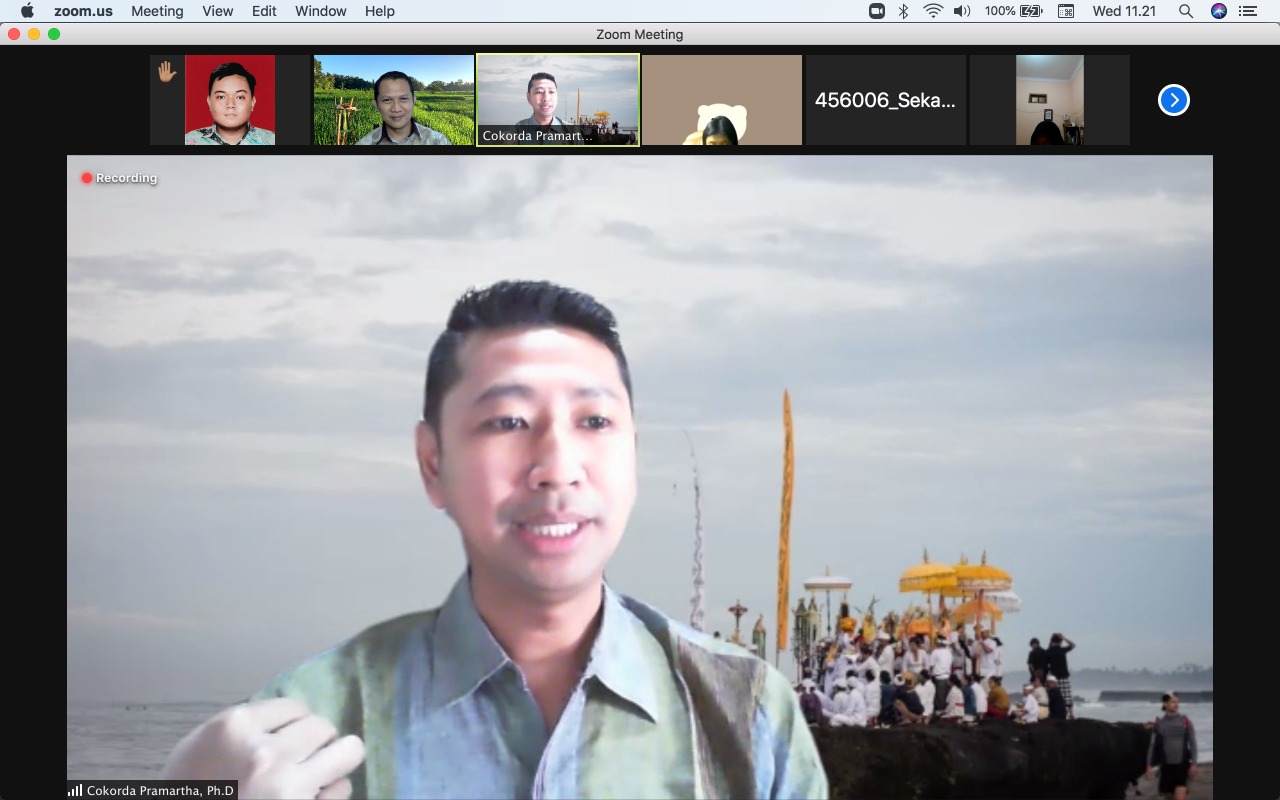
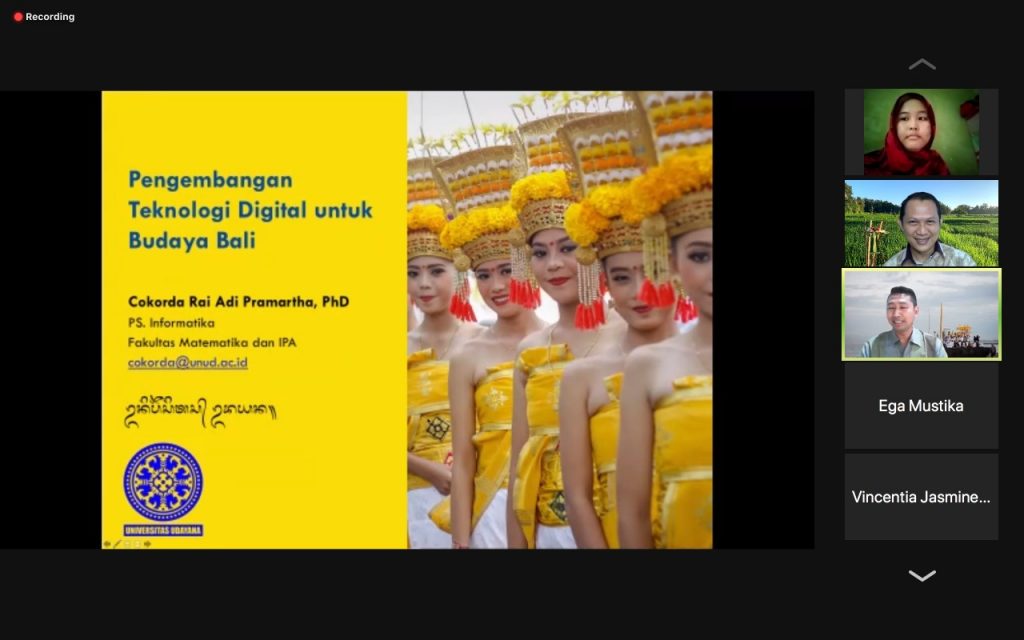
  • Prof. Cokorda Rai Adi Pramartha, Udayana University
  • Dr. Yishan Huang, Australian National University